Disc golf discs
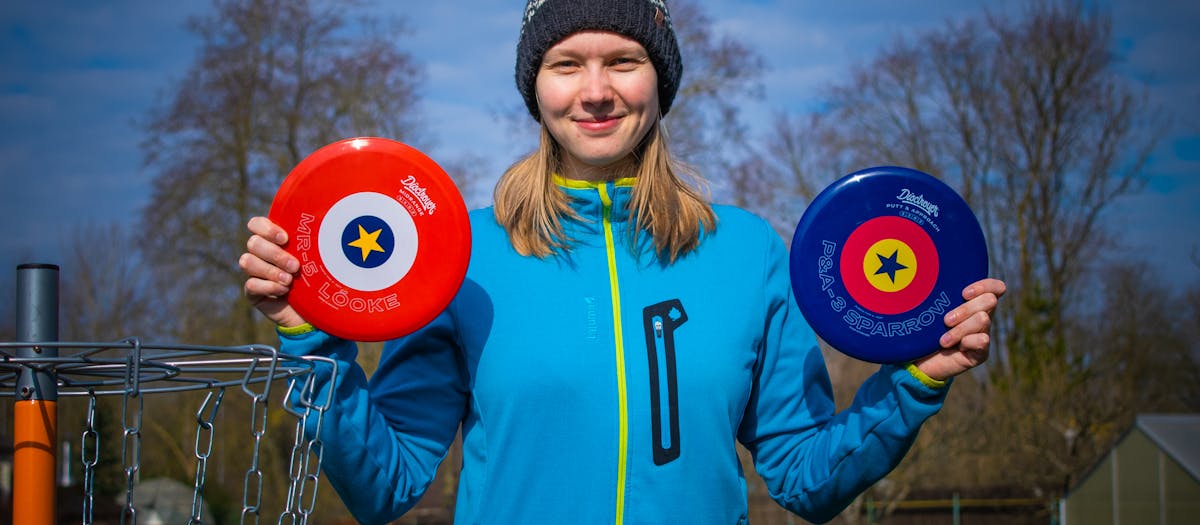
Every golf disc has four numbers stamped on it, and once you can read them you will never buy the wrong disc again. This silo decodes the flight-number system — speed, glide, turn and fade — explains plastic types in plain terms, and points you to picks for each type of disc. It is the spec layer the manufacturer FAQs and retailer pages explain worst, and the one a beginner gains the most from.
How to read flight numbers
Flight numbers are four figures, written in a fixed order: speed, glide, turn and fade. A disc stamped 9 | 5 | -1 | 2 is speed 9, glide 5, turn -1, fade 2. The numbers assume a right-handed backhand throw — the most common throw and the standard the system is built around. Here is what each one means.
Speed (1 to 14) — how fast you must throw it
Speed is the arm speed the disc needs to fly as designed, not how fast it travels or how far it goes. High-speed discs have wide, sharp rims that need a fast throw; throw one slowly and it flies worse, not better. Putters are speed 2 to 3, midranges 4 to 5, fairway drivers 6 to 9, and distance drivers 10 and up. Beginners belong at the lower end — a speed-7 fairway driver will outfly a speed-12 distance driver for a slow arm.
Glide (1 to 7) — how long it stays in the air
Glide is how well a disc floats at slower speeds. More glide carries further for the same throw, which helps a beginner squeeze extra distance out of a slower arm. The trade-off is a little less control in wind and on precise shots. For a first driver, lean toward more glide.
Turn (+1 to -5) — how much it curves right early
Turn is how much the disc bends to the right during the fast, early part of its flight (for a right-handed backhand). The number is zero or negative; -3 turns hard right, 0 resists turning. A disc that turns easily is understable, and this is the beginner secret — understable discs fly straighter for a slow arm, because the turn cancels out the natural left-hooking fade. Look for negative turn.
Fade (0 to 5) — how hard it hooks left at the end
Fade is how sharply the disc dives back to the left as it slows at the end of its flight. A 0 finishes nearly straight; a 4 dives hard left. High fade is reliable in wind and useful for shaped shots, but it never flies straight for a slow arm. For a first bag, want low fade.
Plastic types, in plain terms
The same disc mould is sold in several plastics. The plastic does not change the flight numbers on day one, but it changes the price, the grip, and how long the disc holds its flight before wearing in.
- Base plastic (Innova DX, Discraft Pro-D, Dynamic Discs Prime) — cheapest, grippy, wears in fastest. Great for putters and for beginners learning feel, and cheap to lose in the woods.
- Premium plastic (Innova Star and Champion, Discraft ESP and Z, Dynamic Discs Lucid) — pricier, durable, holds its original flight for far longer. Worth it for drivers you want to stay consistent.
A disc gradually turns more understable as it wears in, which is why a beaten-in base-plastic disc flies straighter than a fresh copy. That is a feature, not a flaw — many players keep a beat-in disc precisely for its straighter flight.
The three disc types
The discs in your bag fall into three families, by speed and job.
- Putters (speed 2 to 3) — for putting into the basket and short, accurate throws. The most-thrown disc, and the one where a consistent feel matters most. Repeat-buyers stock these deepest.
- Midranges (speed 4 to 5) — straight, predictable, for the middle of the hole. Beginners are often surprised how often this is the right disc.
- Drivers — fairway drivers (speed 6 to 9) for controllable distance, and distance drivers (speed 10+) for maximum range once your arm is fast enough. Beginners should stick to fairway drivers.
Featured guides
The current published guides in this silo. More land each batch.
Landing next: Best disc golf driver, Best midrange discs, Best understable discs, and Best disc for forehand.
Discs for different players
For a slower arm or new players
Go lighter and more understable. A light, high-glide, understable disc flies straight and far for a slow arm, where a heavy, overstable disc would stall and fade. This is also the right advice for many women and most kids starting out — it is about arm speed, not anything else.
For wind
Wind is where overstable discs earn their place. A headwind makes a disc act more understable (so it turns and rolls), and a more overstable disc resists that. But a beginner is better off avoiding strong wind than buying a fistful of overstable discs to fight it. Learn the calm-day throw first.
For forehand
A forehand (or flick) curves the opposite way to a backhand, so a slightly more overstable disc often suits it. It is a useful second throw for tight lines and wind, but learn backhand first — the flight numbers and most instruction assume it. A dedicated forehand guide lands in a later batch.